
What the match score measures, and what a 100 does and does not say
You did your workout, the app links it to your plan and puts a number next to it. That number does not say whether you trained well. It says how close you stayed to the planned session.
In short
- The match score has three parts.
- On an easy run, an easy heart rate says little.
- A high score means the session was what was planned.
- A low score is information, not a punishment.
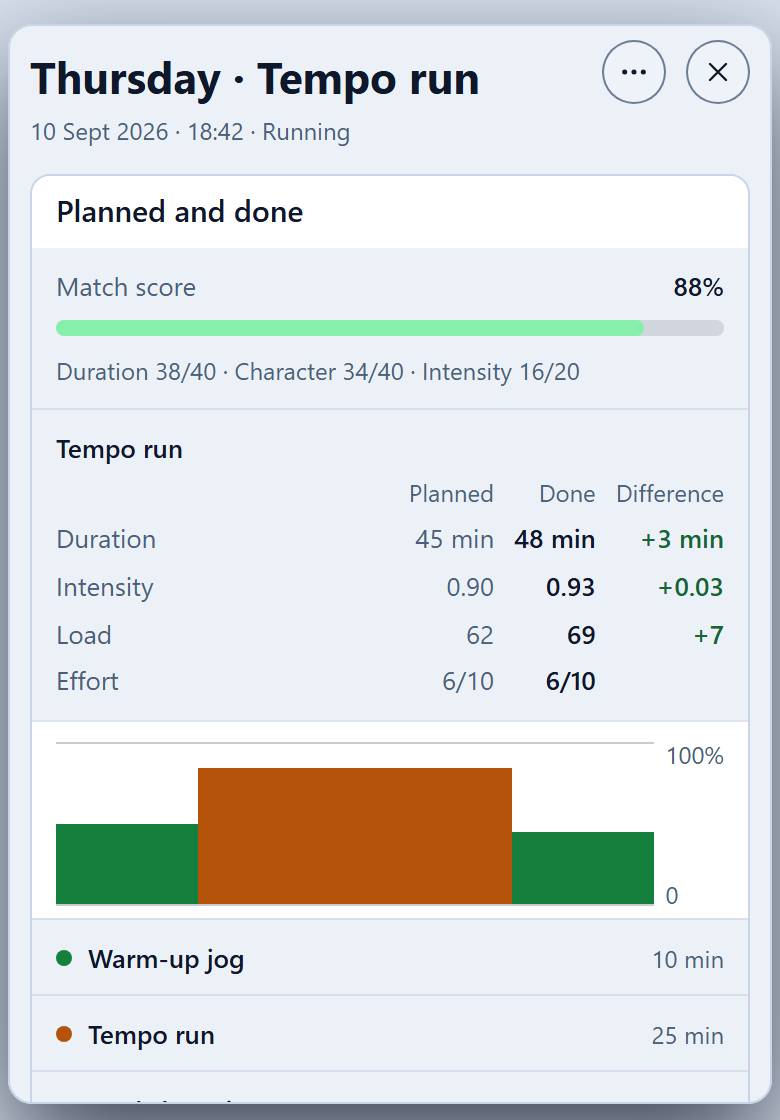
1.Three parts, one number
The match score has three parts. Duration counts up to forty points and says how close you stayed to the planned time. Up to ten percent longer or shorter gets you all the points. Character also counts up to forty and says whether you did the kind of work that was planned: easy where easy was asked, hard where hard was asked. Intensity counts up to twenty and says how hard it was compared with what the plan expected.
Each part looks at what was measured. With heart rate zones, character sees whether you stayed in the zones the session asked for. Without heart rate, your pace or power counts. With no zone time, character stays in the middle.
Your own effort rating counts too. If your heart rate stayed mostly in zones 1 and 2, and you rated the session at or below what the plan expected, that confirms the session was easy.
| Part | Points | What it measures |
|---|---|---|
| Duration | Up to 40 | How close you stayed to the planned time |
| Character | Up to 40 | Whether you did the kind of work that was planned |
| Intensity | Up to 20 | How hard it was compared with what the plan expected |
2.Why a recovery run is measured on pace
On an easy run, an easy heart rate says little. In that range your heart rate barely moves with your pace. You can run a recovery run at endurance pace without your heart rate ever going above the band.
If your own runs show that your heart rate responds flatly there, your training card gives a recovery run with a pace band. The score then measures it on that pace too. If you ran faster than the band, intensity is higher than planned, even if your heart rate stayed low. If your recovery run has a heart rate ceiling, time above it also costs intensity points, and Planned and done says how many minutes that was.
An endurance run works differently. There you belong in the endurance zone, and an easy heart rate across the whole session shows you did what was asked. If you run it on heart rate, the score measures intensity on your heart rate too. Up to 15 percent of the time above the band costs nothing, on a climb for example. If you spent longer above the band, or your average was above it, that costs points. Slightly easier than the band costs nothing. If your average was more than 5 bpm below the band, that costs a few points, four at most: that easy, the stimulus is smaller. If you run it on pace and ran faster than the band, a line next to the score says so, with no deduction.
3.What to do with the score
A high score means the session was what was planned. Nothing more. If your plan scores a hundred every week and you still do not improve, the execution is not the problem. You see that in your form and your signals, not in this number.
A low score is information, not a punishment. If the session was shorter, your plan works with what you did. If you ran an easy session too hard, you read that once, with what you can do differently next time.
A workout with too low a score is not linked to your plan automatically. You can link it yourself, and the score then stays as it was measured.
Frequently asked questions
My score went up later without me doing anything. How is that possible?
The score is recalculated when the measurement behind it changes, for example when zone time from your watch arrives later. The link to your plan stays. Only the number follows the new measurement.
I ran shorter because I had no time. Is my score always low then?
On duration, yes, and that is right: the session was shorter than planned. Character and intensity can still be high. Your plan works with the shorter session and adjusts the rest of the week to it.
Does a session without heart rate count for less?
No. Without heart rate the score looks at your pace or power. Only character then stays in the middle, because there are no zones to compare with.
Do I have to link every workout to a plan?
No. A standalone workout counts towards your load and your form as usual. The match score only exists for workouts that belong to a planned session.
In the app
Further reading
What the plan expected and what you gave: your effort after a session
After your session the slider already sits on a suggested number, with the effort your plan expected below it. Only the number you choose yourself counts as your verdict.
Recovery run: why you run it slower than you think
A recovery run feels easy and your heart rate stays low, yet you often run it too fast. Here you read why your heart rate says little there and why pace is what counts.
Why your heart rate in zone 2 sometimes tells you almost nothing
In the easy range your heart rate responds little and late. It also creeps up on its own during a long run. Why a zone boundary says little there, and what to steer by instead.
Trimetra puts every linked workout next to the planned session, on the measure that counts for that session. Your plan then works with what you actually did.