
What are strides in running, and how do you run them?
Strides are short bursts of 15 to 30 seconds in which you speed up briskly but relaxed, with plenty of recovery in between. They make your running stride smoother and cost little, as long as you keep them relaxed.
In short
- A stride is a short acceleration of about 15 to 30 seconds.
- Strides mainly train your nervous system and your muscles, not your aerobic fitness.
- You do strides after an easy run or at the end of your warm-up, never cold.
- Do not steer a stride by heart rate.
1.What a stride is
A stride is a short acceleration of about 15 to 30 seconds. You build up to a brisk pace in a few seconds, hold it briefly and then let it ease off.
It is not a sprint. You run fast, but in a way that keeps your shoulders, hands and jaw loose. If you have to strain to hold the pace, you are going too fast.
Between two strides you jog or walk for a minute or longer. So you start each stride almost fully rested. That keeps it practice in running fast and smooth, and stops it from turning into an interval session.
2.What strides do
Strides mainly train your nervous system and your muscles, not your aerobic fitness. Your heart and lungs have little to do in 20 seconds. Your legs do learn to move fast without tensing up, with short ground contacts and a higher step rate.
That helps your running economy: how much energy a pace costs you. With better running economy you run the same pace with less effort. Research on running economy shows that short, fast and explosive work helps, alongside plenty of easy kilometres. There is little research on strides themselves, so the case for them comes from that broader work.
A second effect is that running fast stays familiar. If you only run easy, you lose the feel for a quick stride. A few strides keep that feel, also in weeks with little faster work.
Because they are short and you recover fully, they barely tire you. That is why they also fit into a week in which everything else is easy.
3.How to run them
You do strides after an easy run or at the end of your warm-up, never cold. Your muscles should be warm before you run fast.
Do 4 to 8 of them. Pick a flat stretch without bends, or a gentle uphill. Uphill, the slope slows you down by itself and asks for a strong push-off.
Build up each stride. In the first seconds you speed up gradually, then you run a few seconds at your briskest pace and at the end you let the pace drop again. Do not brake abruptly.
Run tall, with low shoulders and relaxed arms swinging along your body. Your foot lands roughly under your hip. Think quick and light, not hard and heavy.
After each stride, jog or walk until your breathing is calm. Only start the next one when you can speed up smoothly again.
4.When to skip them
If you feel something in your calf, Achilles tendon or hamstring during a stride, stop and jog it out. Running fast loads those spots more than an easy run.
If you are stiff or tired from a hard session the day before, leave them out. A stride should feel smooth, and with heavy legs it will not.
If you have only just started running, your first goal is to run easy for longer without stopping. Strides come after that.
5.What Trimetra does with this
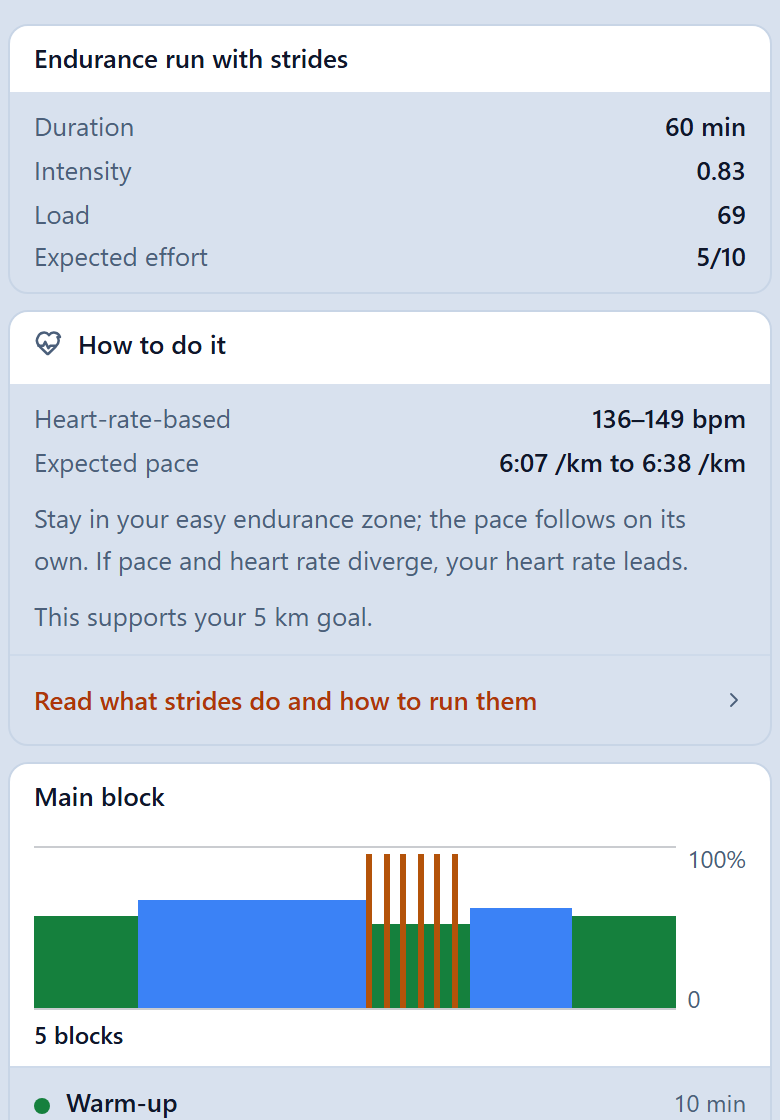
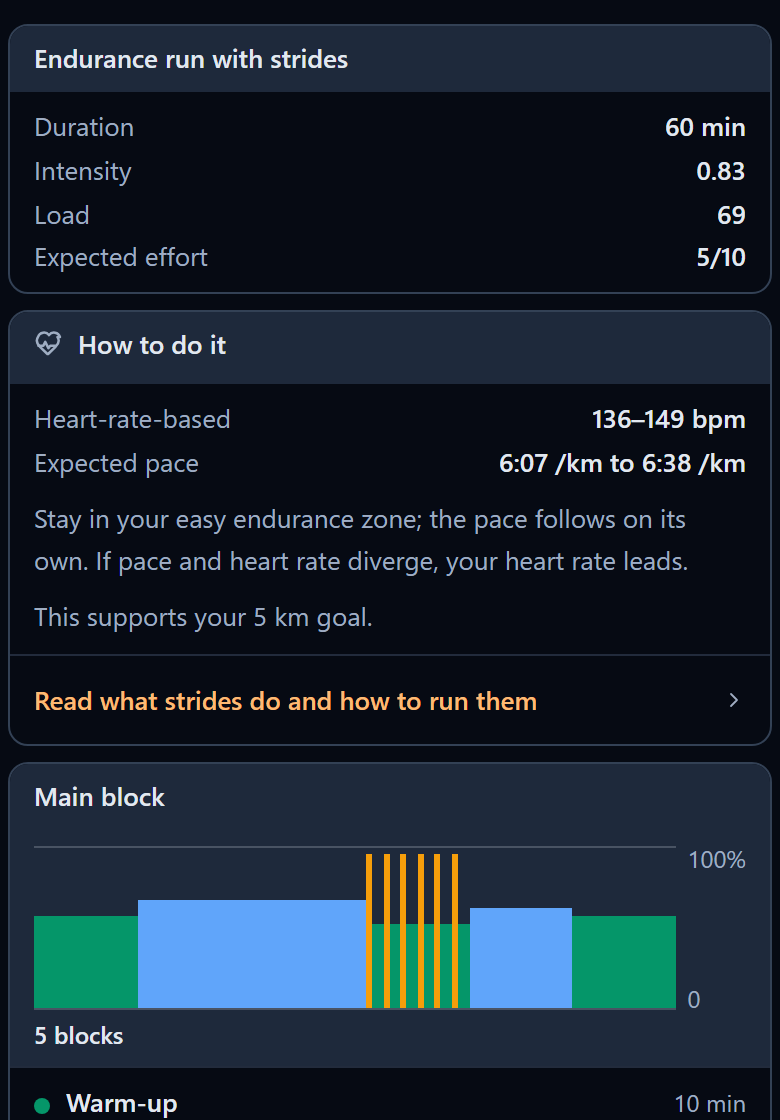
Strides appear in two places in your plan. The first is the Endurance run with strides: a normal endurance run with 4 to 6 strides of 20 seconds near the end, each with a minute of jogging or walking between, followed by a few minutes of easy jogging. The longer the run, the more strides. Not every endurance run gets them, because your plan varies the form of your endurance runs.
The second is the Technique & cadence session. After an easy start you do two or three drills of 30 seconds, such as skipping, high knees and butt kicks, with 30 seconds of recovery. Then come six to eight strides of 20 seconds with a minute of recovery, fewer in a short session. You finish with an easy jog. You see this session less often than the endurance run with strides. It belongs to the calmer plan for a beginner runner and for the goal to build recovery, in a week with many running days.
The strides come with a pace band, a little faster than your threshold pace. If you do not have a threshold pace yet, or you run by feel, there is no pace and you run them briskly but relaxed.
Do not steer a stride by heart rate. Twenty seconds is too short for your heart rate to catch up. So your zone breakdown afterwards shows at most a few minutes just above your endurance zone, not the pace you ran.
The strides count at their own height in the load of the session, and an endurance run with strides weighs about the same as a normal endurance run of the same length. If you are a beginner or you are on a start-to-run build-up, your endurance run stays without strides. The same goes after a race and when you have reported a tendon complaint.
Frequently asked questions
How fast should a stride be?
Fast, but not flat out. You should be able to stay relaxed, with loose shoulders and a calm face. Your plan shows a pace band with it, a little faster than your threshold pace.
Are strides the same as sprints?
No. In a sprint you go flat out and tense everything. A stride stays below your sprint and feels smooth. That is why you can do six after an endurance run without them costing you much.
Why do my strides not show up in my heart rate?
Twenty seconds is too short for your heart rate to rise with them. It lags behind your pace and drops again during recovery. So look at your pace and your feel.
Can I do strides when they are not in my plan?
You can, after an easy run. Do four to six on a flat stretch, with enough recovery between. Leave them out when you are tired or feel pain somewhere.
In the app
Further reading
Recovery run: why you run it slower than you think
A recovery run feels easy and your heart rate stays low, yet you often run it too fast. Here you read why your heart rate says little there and why pace is what counts.
How fast should I run as a beginner?
As a beginner you run slower than you think, at a pace where you can still talk. Here you read how to find that pace and why run-walk blocks help.
Why an 8.7 km tempo run counts as 10 km
Your tendons count landings and how hard they are, not just distance. That is why a fast or climbing kilometre weighs more in your plan than an easy one.
Strides are short, relaxed accelerations that keep your running stride smooth without tiring you, and in Trimetra they are part of the Endurance run with strides and the Technique & cadence session.
Sources (4)
- Saunders P.U., Pyne D.B., Telford R.D., Hawley J.A. (2004). Factors affecting running economy in trained distance runners. Sports Med 34(7): 465–485.
- Barnes K.R., Kilding A.E. (2015). Strategies to improve running economy. Sports Med 45(1): 37–56.
- Paavolainen L., Häkkinen K., Hämäläinen I., Nummela A., Rusko H. (1999). Explosive-strength training improves 5-km running time by improving running economy and muscle power. J Appl Physiol 86(5): 1527–1533.
- Daniels J. (2014). Daniels’ Running Formula, 3rd ed. Champaign, IL: Human Kinetics.